Garage and Attic Water Heater Risks Homeowners Overlook
Garage and attic water heaters in Katy hide leaks, rust, and code risks. Learn the warning signs, inspection schedule, and when to call a pro.
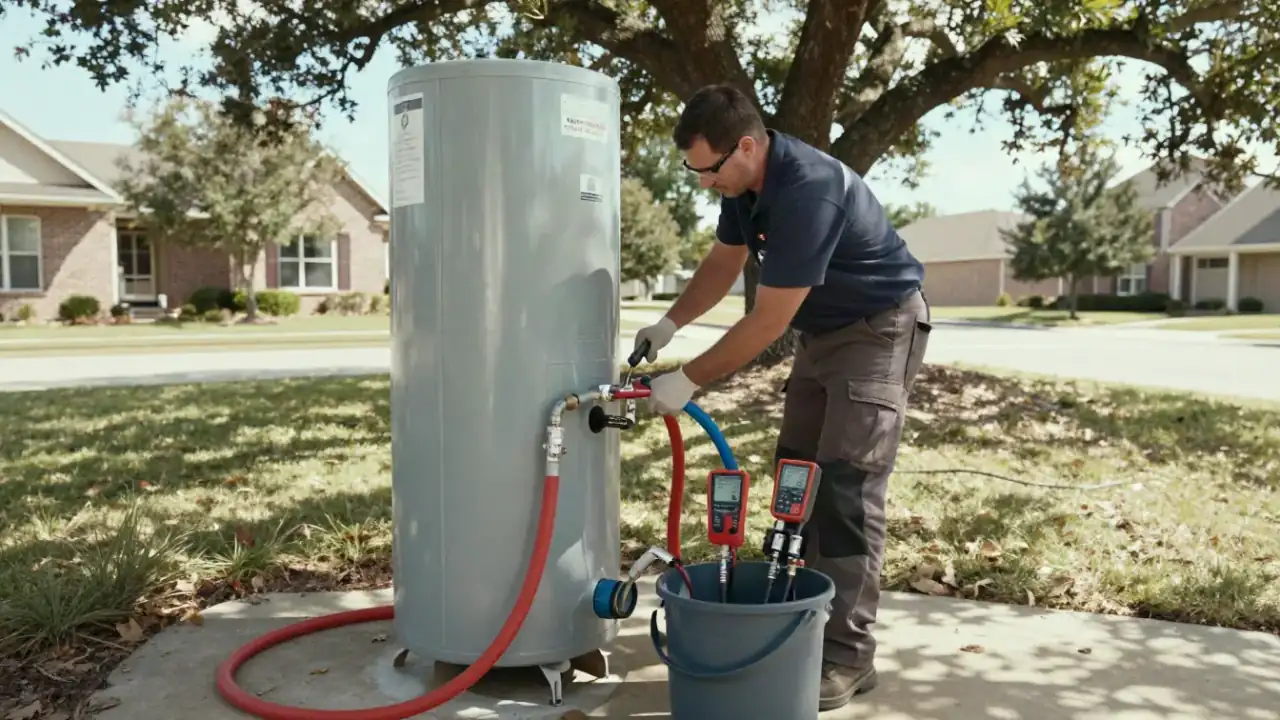
The biggest risks with garage and attic water heaters in Katy are hidden leaks, rust from humidity, and code violations that only show up during inspection. A tank in the attic can drip for weeks before you see a stain on the ceiling, and a garage unit can corrode faster than a closet unit because it breathes 90-degree air all summer. This post covers what to check, how often to check it, and when a repair turns into a replacement.
We work on garage and attic units across Katy every week, and the same three failures show up over and over: a failed pan, a rusted anode rod, and a drain line that was never routed to code. None of them are expensive to fix early. All of them are expensive to fix late.
Why Garage and Attic Water Heaters Are Riskier Than Closet Units
Garage and attic water heater risks in Katy TX come down to one thing: the unit sits in an unconditioned space that swings 40 degrees between winter and summer. A closet unit inside the house lives at 72 degrees year-round. A garage unit in August sits in 105-degree air, and an attic unit can hit 130 degrees by 2 p.m.
That heat does three things. It accelerates corrosion on the tank fittings. It cooks the plastic dip tube and the T&P valve. And it pushes the unit past its design limits during the hottest six weeks of the year, which is exactly when you need hot water the least and notice a failure the most.
Attic units add a second problem: gravity. A 50-gallon tank holds roughly 400 pounds of water. If the pan leaks or the drain line clogs, that water goes straight down through your ceiling, insulation, and drywall. We have pulled soaked insulation out of Katy attics more times than we can count.
Garage units have their own issue. Texas code requires a garage water heater to sit at least 18 inches above the floor if it's in a space where flammable vapors can collect. Many older Katy homes have the tank sitting directly on the slab. That's a violation, and it's one an inspector will flag the day you sell.
Garage Water Heater Risks Katy Homeowners Face Every Summer
Garage water heater risks Katy homeowners run into most often are corrosion, pest damage, and impact from stored items. The garage is where you keep the mower, the bikes, and the holiday boxes. It's also where the tank lives, usually in a corner with no clearance.
Here's what we find when we open a garage unit that hasn't been serviced in three or four years:
- Rust on the bottom fitting. The first sign is a chalky white or orange ring where the cold inlet meets the tank. Once that ring is wet to the touch, the tank is on borrowed time.
- A clogged T&P valve. Katy water runs hard, and the temperature and pressure relief valve can scale shut. If it can't open, pressure has nowhere to go.
- Chewed insulation. Rodents in the garage will nest in the fiberglass blanket around the tank. That blanket is there to hold heat, and once it's torn, the unit runs longer.
- A missing or cracked drain pan. A $30 pan saves a $3,000 floor repair. We replace more of these than any other part.
If you notice a puddle under the tank or rust streaks on the side, that's a leaking tank repair Katy TX job, not a wait-and-see. A slow weep turns into a burst seam fast once the tank wall thins.
One more garage-specific risk: the pilot light. If your unit is gas and the garage door stays open on a windy day, the pilot can blow out. That's a pilot light and thermocouple repair Katy TX call, and it's usually a 30-minute fix.
Attic Water Heater Dangers Katy TX Homeowners Can't See
Attic water heater dangers Katy TX homeowners miss are the ones happening above the ceiling, out of sight. You don't walk past your attic tank every day. You walk past the stain on the ceiling three weeks after the leak started.
The attic is the worst place in the house for a tank. It's the hottest space in summer, the coldest in a January freeze, and it's usually framed with a plywood platform that wasn't built for 400 pounds of static load. We've seen platforms sag two inches under a full tank.
Three attic-specific failures we fix regularly:
- Pan overflow. The pan under the tank has a drain line that runs to a soffit or a drip edge. If that line clogs with insulation or wasps, the pan fills and overflows onto the ceiling.
- Condensation drip. In a humid Katy summer, a cold-water inlet line sweats. That moisture runs down the pipe and drips onto the platform, which rots the wood over time.
- Freeze damage. The February 2021 freeze cracked more attic tanks in Katy than any other single event. If your attic unit is on an exterior wall and the power goes out, the lines can freeze again.
An Water Heater Repair in Cinco Ranch call is what most homeowners make after they see the ceiling stain. By then, the drywall is already wet. If you catch it at the pan, you're looking at a $150 to $300 repair instead of a $2,000 drywall and insulation job.
Is It Safe to Have a Water Heater in the Attic in Katy TX?
Yes, an attic water heater is legal and safe in Katy TX if it has a properly sized pan, a drain line that terminates outside the house, and a platform rated for the tank's full weight. The danger isn't the location. It's the missing parts.
Texas follows the International Plumbing Code, and the attic installation rules are specific. The pan must be at least 1.5 inches deep and wide enough to catch a full tank failure. The drain line must run to an approved location, not just stop at the edge of the platform. The platform must support the tank plus the water weight.
What we find in Katy attics is usually one of three shortcuts: no pan at all, a pan with no drain line, or a drain line that dumps into the attic floor. All three are code violations, and all three turn a small leak into a ceiling replacement.
If your attic unit is more than 10 years old and you've never had it inspected, that's the first thing to fix. A Water Heater Repair in Seven Meadows inspection takes about 45 minutes and tells you exactly what's missing.
How Often Should Attic Water Heaters Be Inspected in Katy Texas?
Attic water heaters in Katy Texas should be inspected once a year, ideally in early spring before the summer heat load hits. Garage units should get the same annual check, plus a quick visual look every three months.
Here's the schedule we recommend to our Katy customers:
- Every 3 months: Look at the tank. Check for rust, moisture, or a swollen pan. Two minutes with a flashlight.
- Every 12 months: Full inspection. Test the T&P valve, check the anode rod, flush the tank, and verify the drain line is clear.
- Every 5 to 6 years: Replace the anode rod. This is the single cheapest thing you can do to extend tank life.
- Every 8 to 12 years: Plan for replacement. A tank in an attic or garage rarely makes it past 12 years in Katy's heat.
An annual anode rod and tank flush maintenance Katy TX visit runs $150 to $250 in 2026. A tank replacement runs $1,200 to $2,400 installed, depending on size and whether you go tank or tankless. The math isn't close.
If you have a tankless unit in the attic, the schedule shifts. Tankless units need a descaling flush every 12 to 18 months in Katy because our water is hard. Skip it and the heat exchanger scales up, which cuts flow and raises your gas bill.
Common Mistakes We See With Garage and Attic Units
The mistakes we see most often with garage and attic water heaters are all about access and neglect. Out of sight really is out of mind, and that's how a $200 repair becomes a $2,000 problem.
Here's the short list:
- Storing boxes against the tank. You need 18 inches of clearance on all sides. Cardboard against a hot tank is a fire risk.
- Ignoring the pan. A cracked pan is a $30 part. Replacing the ceiling below it is not.
- Never testing the T&P valve. Lift the lever once a year. If water doesn't flow, the valve is stuck.
- Running the unit past 12 years. Tank walls thin from the inside. You can't see it from the outside until it fails.
- Skipping the anode rod. This is the part that sacrifices itself so the tank doesn't rust. Replace it every 5 to 6 years.
- Not labeling the breaker. When the tank fails at 11 p.m., you want to kill power fast. Label the breaker panel.
One mistake that costs Katy homeowners the most: assuming a garage unit is fine because the floor is dry. A tank can leak into the pan and evaporate in the summer heat for weeks before it shows on the floor. Check the pan, not the floor.
If you're not sure what you're looking at, a Water Heater Repair in Nottingham Country inspection will tell you in under an hour. We check the pan, the anode, the T&P valve, the drain line, and the flue if it's gas.
When to Call a Professional
Call a professional when you see water where it shouldn't be, smell gas, or hear the tank popping. Those three signs mean the unit is already failing, and the fix is not a DIY job.
Here's when to pick up the phone:
- Water in the pan or on the floor under the tank.
- Rust streaks on the tank body or fittings.
- Popping or rumbling sounds during heating.
- No hot water, or hot water that runs out in under five minutes.
- A gas smell near the unit. Leave the house and call from outside.
- The T&P valve is dripping or won't open.
Our team handles garage and attic units across Katy, including the tight attic access and the 18-inch garage platform work. We find the problem, fix it, and test the unit before we leave. If the tank is past saving, we'll tell you straight and give you a replacement quote on the spot.
If you want a baseline on a unit you've never had inspected, start with a Water Heater Repair Katy TX visit. We'll tell you what's fine, what's marginal, and what needs to go.
Frequently Asked Questions
Is it safe to have a water heater in the attic in Katy TX?
Yes, if it has a 1.5-inch pan, a drain line that terminates outside the house, and a platform rated for the full tank weight. Without those three, an attic tank is a ceiling leak waiting to happen. Annual inspections catch missing parts before they cause damage.
What are the risks of a garage water heater in Katy?
The main risks are corrosion from summer heat, pest damage to insulation, impact from stored items, and a missing 18-inch platform. Garage units in Katy often fail two to three years sooner than closet units because they sit in 100-degree air all summer.
How often should attic water heaters be inspected in Katy Texas?
Once a year, ideally in early spring before the summer heat load. Do a two-minute visual check every three months for rust, moisture, or a swollen pan. Replace the anode rod every five to six years and plan for tank replacement at 8 to 12 years.
Who inspects water heaters near me in Katy?
Katy Water Heater Repair inspects garage, attic, and closet units across Katy and the surrounding areas. We check the pan, anode rod, T&P valve, drain line, and flue, then give you a straight report on what needs fixing now and what can wait.
Can a garage water heater leak without me noticing?
Yes. In summer, a slow leak can evaporate from the pan before it reaches the floor. Check the pan itself, not the floor, and look for rust rings on the tank fittings. A dry floor does not mean a dry tank.
Get Help With Water Heater Repair in Katy
If your garage or attic unit is showing any of the signs above, don't wait for the ceiling stain. We inspect, repair, and replace garage and attic water heaters across Katy, and we'll tell you honestly whether it's a fix or a replacement.
Call Katy Water Heater Repair at (281) 326-6032 to schedule your inspection.