Tankless Water Heater Flushing: Why Descaling Matters
Katy's hard water scales tankless heat exchangers fast. Here's why descaling matters, how often to flush, what it costs, and what happens when you skip it.
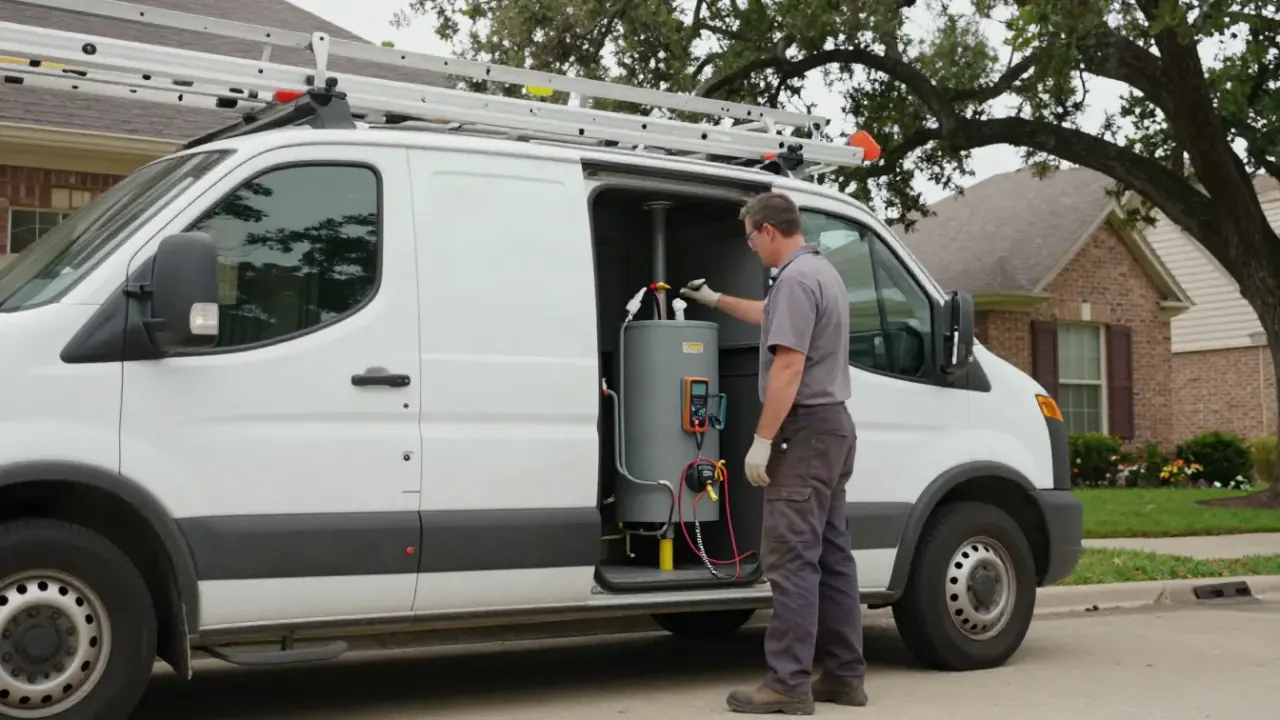
Tankless water heater flushing in Katy TX matters because our water is hard enough to coat a heat exchanger in scale within 12 to 18 months, and that scale is what kills hot water output, flow rate, and eventually the unit itself. Descaling dissolves that mineral layer with a mild acid pump flush before it hardens into a permanent blockage. Below we cover how the process works, how often you actually need it here, what it costs in 2026, and the mistakes that turn a $200 maintenance job into a $2,000 repair.
We run these flushes every week across Fort Bend and Harris County, and the difference between a tankless unit that lasts 20 years and one that dies at year eight is almost always maintenance. If you want the short version: flush it once a year in Katy, or every eight months if you are on well water or in a newer subdivision with fresh concrete-lined mains.
Why Descaling Matters for a Tankless Water Heater in Katy TX
Tankless descaling in Katy is the single highest-return maintenance task you can do for a unit that cost you $1,800 to $3,500 installed. The heat exchanger on a tankless heater is a coil of copper or stainless tubing with an inside diameter roughly the width of a pencil. Scale narrows that passage. When it narrows, water moves slower, the burner has to fire longer to hit your set temperature, and the metal runs hotter than it was designed to.
Katy's municipal water runs about 8 to 12 grains per gallon of hardness on the west side of the Grand Parkway, and higher in pockets of Fulshear and the rural well systems north of I-10. Anything above 7 grains is considered hard. At 10 grains, a family of four pushing 180 gallons a day through a tankless unit deposits measurable scale in under a year.
Here is what that means in practical terms:
- Efficiency loss: a scaled heat exchanger burns 8 to 15 percent more gas to deliver the same hot water.
- Flow restriction: a 9.5 GPM unit can drop to 6 or 7 GPM once the coil is coated.
- Shortened lifespan: scale insulates metal, metal overheats, and overheated metal cracks.
We see this pattern constantly in the older sections of Water Heater Repair in Cinco Ranch, where homes built in the 1990s and 2000s are now on their second or third tankless unit - and the ones that got annual flushes are still running.
What Actually Happens Inside a Tankless Heat Exchanger
Calcium and magnesium dissolved in Katy tap water precipitate out as solid carbonate when the water heats. That is the same reaction that crusts up a coffee maker, just at a larger scale and inside a $2,500 appliance. The deposit starts as a thin chalky film on the hottest part of the coil - usually the first two or three passes - and thickens outward.
A proper tankless flush reverses that. We isolate the unit at the service valves, pump a food-grade descaler solution (typically white vinegar at 4 to 5 percent acetic acid, or a commercial citric-based cleaner) through the heat exchanger with a small submersible pump and two hoses, and let it circulate for 30 to 60 minutes. The acid dissolves the carbonate back into solution, and we flush it out with clean water.
On a well-maintained unit, the discharge water runs clear after 20 minutes. On a unit that has not been touched in four years, it comes out the color of weak tea and sometimes carries visible grit. We have pulled a full cup of scale flakes out of a single flush on a Katy unit that was still producing hot water - barely.
How Often Should You Flush a Tankless Water Heater in Katy TX?
Once a year is the baseline for Katy, and every eight months if you are on well water, have a whole-house softener that is not regenerating properly, or run a large household with heavy simultaneous demand. Manufacturers like Rinnai, Navien, and Rheem all publish annual descaling in their maintenance schedules for hard-water regions, and Southeast Texas qualifies.
Three factors push you toward the shorter interval:
- Water hardness above 10 grains per gallon. Anything on the west side of Katy, plus Fulshear and the rural systems, hits this.
- High usage. A family of five with two showers running at 6 a.m. cycles more water through the coil than a retired couple.
- Preheating or recirculation loops. These push water through the exchanger more often, which accelerates deposition.
If you have never flushed your unit and it was installed more than two years ago, do it now and then reset to an annual schedule. The first flush on a neglected unit is the one that matters most.
Signs Your Tankless Unit Is Already Scaled Up
The earliest warning is temperature fluctuation at the tap - the shower runs hot, then cool, then hot again as the unit cycles to compensate for restricted flow. That surging is the burner hunting for a setpoint it cannot hold.
Other signals we hear from Katy homeowners:
- Hot water takes noticeably longer to arrive at the fixture than it used to.
- Two showers at once now drops pressure, where it used to be fine.
- The unit makes a rumbling or kettling sound while firing.
- Error codes tied to overheat or flow, often intermittent at first.
- Visible white crust around the inlet and outlet fittings.
If you are seeing any of these, you are past due. A tankless flush and descaling Katy TX service usually clears the symptom in a single visit, and we will tell you honestly if the exchanger is too far gone to save.
What Happens If You Don't Descale Your Tankless Heater in Katy
Skip descaling long enough and the failure stops being reversible. Scale that has hardened into a solid layer inside the coil cannot be pumped out with vinegar - it has to be chipped, replaced, or the whole heat exchanger assembly swapped, which on most units means replacing the unit.
The progression we see on neglected Katy units runs roughly like this:
- Year 1-2: efficiency drops, flow rate falls, no visible symptoms yet.
- Year 3-4: temperature surging, error codes, longer recovery times.
- Year 5-7: heat exchanger cracks from localized overheating, water leaks from the coil, unit fails outright.
A cracked exchanger on a tankless unit is not a repair - it is a replacement. That is a $2,500 to $4,000 job versus a $175 to $275 annual flush. The math is not close.
We also see scale cause secondary damage: restricted flow stresses the inlet filter, the flow sensor drifts out of calibration, and the bypass valve starts sticking. Those are all tankless unit repair Katy TX calls that would never have happened on a flushed unit.
How Much Does Tankless Flushing Cost in Katy Texas?
Typical 2026 pricing for a professional tankless flush in the Katy area runs $175 to $275 for a single unit, including the descaler, the pump setup, and a flow and temperature check afterward. Two-unit homes - common in the larger houses out in Elyson and Jordan Ranch - usually land in the $300 to $450 range.
What drives the price up or down:
- Access. A unit mounted in an attic or a tight garage corner takes longer to set up than one on an exterior wall.
- Condition. A first-time flush on a neglected unit may need two or three circulation cycles.
- Isolation valves. If your installer skipped the service valve kit, we have to add one before we can flush - usually $75 to $125 in parts and labor.
- Bundled maintenance. Combining the flush with an annual inspection or a filter clean drops the per-task cost.
Compare that to the cost of a heat exchanger replacement and the flush pays for itself the first time it prevents a failure. For most Katy households, we recommend scheduling it in the fall - before the winter demand spike - so the unit goes into its heaviest season clean.
Common Mistakes We See on DIY Tankless Flushes
The most common mistake is skipping the isolation valves and trying to flush through the house plumbing. That does not descale the heat exchanger - it just circulates weak acid through your fixtures, which is bad for the fixtures and useless for the coil.
Other errors we get called to clean up:
- Using the wrong acid. Muriatic or pool acid will eat the copper. Food-grade descaler or plain white vinegar only.
- Too short a circulation time. Fifteen minutes does almost nothing on a scaled unit. Thirty to sixty minutes is the working range.
- No post-flush rinse. Residual acid left in the coil corrodes the metal from the inside.
- Forgetting the inlet filter. The little mesh screen on the cold inlet catches most of the debris. If you do not clean it, you have not finished the job.
- Not checking gas pressure or flow rate afterward. The flush is only half the service; verifying the unit actually performs is the other half.
We also see homeowners flush the unit but ignore the recirculation pump on systems that have one. That pump has its own strainer and its own scale problem, and it is a frequent source of "no hot water" calls we handle through no hot water diagnosis Katy TX.
When to Call a Professional
Call us when the unit is throwing error codes, when you have never flushed it and it is more than two years old, when you do not have isolation valves installed, or when the flush water comes out full of grit and you are not sure the exchanger survived. Those are the cases where a DIY attempt can turn a maintenance job into a replacement.
Our team handles tankless water heater service Katy across Cinco Ranch, Firethorne, Grand Lakes, and the surrounding neighborhoods, and we carry the descaler, the pump, and the replacement valves on the truck. We will flush the unit, verify flow and temperature, and tell you straight whether the exchanger is healthy or on its way out.
If you are in one of the newer master-planned communities, we also run regular routes through Water Heater Repair in Elyson and the surrounding areas, so scheduling a same-week flush is usually easy.
Frequently Asked Questions
How often should I flush my tankless water heater in Katy TX?
Once a year, or every eight months if you are on well water or your hardness is above 10 grains per gallon. Katy's municipal supply runs 8 to 12 grains, which is hard enough to require annual descaling. If the unit is more than two years old and has never been flushed, do it now and reset the schedule.
What happens if I don't descale my tankless heater in Katy?
Scale thickens inside the heat exchanger, cutting flow rate by 20 to 30 percent and raising gas use by 8 to 15 percent. Left long enough, the coil overheats and cracks, which means a full unit replacement instead of a $175 to $275 flush. Most neglected units fail between years five and seven.
How much does tankless flushing cost in Katy Texas?
Expect $175 to $275 for a single-unit flush in 2026, including descaler, circulation time, and a post-flush flow and temperature check. Two-unit homes run $300 to $450. Adding isolation valves, if you do not have them, is usually another $75 to $125.
Who does tankless water heater flushing near me in Katy?
We do - Katy Water Heater Repair runs tankless flush and descaling calls throughout Katy, Cinco Ranch, Fulshear, and the surrounding Fort Bend and Harris County neighborhoods. We carry descaler and pumps on every truck, so most flushes are completed in a single visit.
Can I flush a tankless water heater myself?
Yes, if your unit has isolation valves and you use food-grade descaler or white vinegar, circulate for 30 to 60 minutes, and rinse thoroughly afterward. Without isolation valves, or if the unit is throwing error codes, a professional flush is safer and usually cheaper than the damage a bad DIY attempt causes.
Get Help with Water Heater Repair in Katy
If your tankless unit is surging, losing flow, or has not been flushed in over a year, we can get it descaled and verified before it becomes a replacement. Call Katy Water Heater Repair at (281) 326-6032 and we will schedule a tankless flush at your home.